
AI Photo Calorie Counting: What the Research Shows
Quick answer
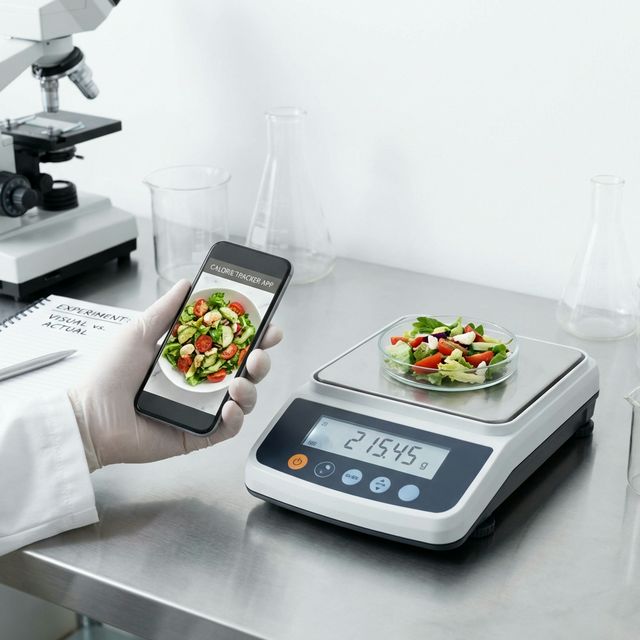
AI photo calorie counting is good at recognizing foods but less reliable at judging portion sizes and hidden ingredients. Recent studies of general AI models found energy errors of roughly 30 to 36% on average from photos alone, with a tendency to underestimate large portions. Adding a short description of ingredients and amounts reduced errors substantially in one study, so treat a photo estimate as a starting point you check.
Key takeaways
- In studies, AI models identify foods in meal photos well but estimate portion sizes and nutrients less accurately, especially for medium and large meals.
- Two 2025 studies found average energy errors of about 30 to 36% when AI models worked from photos alone.
- Giving the AI extra context, such as ingredients and amounts, cut the average energy error from about 31% to 14% in one study.
- Hidden fats, mixed dishes, sauces and look-alike drinks are the most common blind spots for any photo-based method.
- Good light, the whole plate in frame, a size reference and a quick written note all make a photo estimate more useful.
How does AI photo calorie counting work?
You photograph your meal, and the app tries to do three things: find and name each food, estimate how much of each is on the plate, and look up the nutrition for that amount in a food database. Some apps use models built specifically for food, while newer ones use general-purpose AI models that can describe images. Our pillar guide on how AI food tracking works walks through the full pipeline. This article focuses on one question: how well does the photo route actually perform?
How accurate are AI calorie estimates from food photos?
Several recent peer-reviewed studies have tested this by comparing AI estimates against meals with known, weighed contents. The results are fairly consistent: recognition is good, quantities are harder.
| Study | What was tested | Main findings |
|---|---|---|
| O'Hara et al., 2025 | ChatGPT-4 on 114 meal photos from national dietary survey data | Identified foods with 93% precision; meal weight agreed for small meals but not medium or large ones; estimates were more than 10% off for 13 of 16 nutrients, with 11 underestimated |
| Fridolfsson et al., 2025 | Three large language models on 52 standardized food photos in three portion sizes | Best two models had a mean absolute percentage error of about 36% for energy; all models underestimated more as portions grew |
| Rodríguez-Jiménez et al., 2025 | ChatGPT-5 on 195 dishes with increasing amounts of context | Mean absolute percentage error for energy fell from 30.5% with the image alone to 24.4% with added descriptors and 13.9% with a detailed ingredient list |
| Isobe et al., 2026 | 10 AI models and 10 registered dietitians on 15 standardized hospital meal photos | Top models were often within about 10% for energy and carbohydrate, but all AI models overestimated fat by more than 20% on average |
A few cautions apply. These studies tested general AI models under research conditions, not every app on the market, and models change quickly. Photos were often taken in good light from a set angle, which is easier than a dim restaurant table. And a mean percentage error describes the average miss: individual meals can be much closer or much further off.
An earlier review by Höchsmann and Martin concluded that the technology for fully automatic food recognition and portion estimation was still in its infancy, and that less burdensome methods tend to be less accurate. The newer studies suggest real progress, but not yet precision.
Are trained humans better at estimating calories from photos?
Photo-based methods were used in research long before AI. In the Remote Food Photography Method, participants photograph their food before and after eating, and human raters estimate intake by comparing the images with standard portion images, helped by a reference card in each photo. In a validation study by Martin and colleagues, the method was checked against doubly labeled water, a lab technique that measures the energy a person actually uses over several days. In 50 free-living adults over six days, estimated intake differed from the doubly labeled water value by an average of 152 kcal per day, which was not statistically significant.
The same paper shows why completeness matters. In a pilot group that received only standard reminders, intake was underestimated by an average of 895 kcal per day, while a group that received reminders customized to their mealtimes was much closer. Missing photos can cost more accuracy than imperfect estimates of the photos you do take.
Why do photo calorie estimates go wrong?
- Portion size from a flat image. A camera sees area, not depth or density. A tall mound of rice and a thin layer can look similar from above.
- Hidden ingredients. Höchsmann and Martin give butter in mashed potatoes as an example: the type and amount of hidden ingredients often need the eater to add a note. Oil, dressings and sugar are the usual culprits, and our guide to what AI calorie counters miss lists how many calories they add.
- Look-alike foods. The same review notes that diet versus regular soda, and fried versus baked preparation, are hard to tell apart from a picture.
- Mixed and covered dishes. Soups, sandwiches, burritos and salads hide some of their contents. The O'Hara study included meals where some foods were hidden by others for exactly this reason.
- Photo conditions. A systematic review by Dalakleidi and colleagues lists low lighting and irrelevant objects in the scene as sources of error, along with users forgetting to photograph meals and leftovers.
How do you take a food photo the AI can read well?
- Use good, even light. Daylight or a bright room beats a dim table.
- Get the whole plate in frame, with some space around it, so nothing is cut off.
- Shoot from above, and add a side angle for tall foods. Research systems have used a top view to estimate area and a side view to estimate height.
- Include something of known size, such as a fork or a standard plate. The Fridolfsson study prompted models to use visible cutlery and plates as size references.
- Spread foods out so items are not stacked on top of each other.
- Add a one-line note. "Fried in 1 tbsp olive oil, about 150 g chicken" is the kind of context that cut errors in the Rodríguez-Jiménez study.
- Photograph leftovers if you do not finish, or adjust the portion afterwards.
- Review the result and correct any wrong food or amount before saving.
When should you use a photo, and when something else?
| Situation | Photo works well? | Better option |
|---|---|---|
| Plated meal with separate foods | Yes, with a quick check | Photo plus a note on cooking fat |
| Packaged snack or drink | Not ideal | Barcode scan or label |
| Soup, stew, curry or casserole | Rough at best | Recipe entry or a description with amounts |
| Sandwich, wrap or burger | Partly; fillings are hidden | Photo plus a list of fillings and sauces |
| Coffee drinks, soda, alcohol | Poor | Log separately by volume and type |
| Foods you eat every day | Unnecessary | Saved meal or a weighed entry |
Describing a meal out loud can be a fast alternative when a photo would miss key details. Our guide to voice food logging covers how to phrase those entries.
Is a rough photo estimate still worth logging?
Often, yes. A quick photo that gets logged is more useful than a perfect entry you never make, and consistent logging helps you see patterns. The key is to know the likely direction of error, add what the camera cannot see, and judge your intake by your weight trend over a few weeks rather than by any single meal. For a broader look at where calorie and macro errors come from, see can AI calculate your macros accurately.
MyMacro AI is not released yet. Its Hunter Camera is designed to identify foods and portions from a meal photo and estimate macros, with the entry open to edits, and you can join the waitlist to hear when it launches. Whichever app you use, the habits above matter more than the brand.
Frequently asked questions
How accurate are AI calorie counts from photos?
In recent studies, general AI models averaged roughly 30 to 36% error for energy when working from photos alone. They identified foods well but struggled with portion sizes, especially larger meals.
Do AI photo apps overestimate or underestimate calories?
Several studies found a tendency to underestimate, particularly for large portions. One study of hospital meals found AI models overestimated fat, so the direction of error can vary by food.
How can I make photo calorie counting more accurate?
Use good light, keep the whole plate in frame, include a fork or plate for scale, and add a short note about cooking oil, sauces and amounts. Always check the result before saving.
Can a phone camera see oil or butter in food?
Usually not reliably. Research reviews list hidden ingredients like butter and cooking oil as a common gap, so add them yourself.
Is photo logging better than weighing food?
Weighing with a kitchen scale is more precise. Photo logging is faster and lower effort, which some people find easier to keep up, but it is less accurate.
Sources
- An Evaluation of ChatGPT for Nutrient Content Estimation from Meal Photographs, Nutrients (O'Hara et al.) (2025)
- Performance Evaluation of 3 Large Language Models for Nutritional Content Estimation from Food Images, Current Developments in Nutrition (Fridolfsson et al.) (2025)
- Image-Based Dietary Energy and Macronutrients Estimation with ChatGPT-5: Cross-Source Evaluation Across Escalating Context Scenarios, Nutrients (Rodríguez-Jiménez et al.) (2025)
- Accuracy of AI-Based Nutrient Estimation from Standardized Hospital Meal Images: A Comparison with Registered Dietitians, Nutrients (Isobe et al.) (2026)
- Review of the validity and feasibility of image-assisted methods for dietary assessment, International Journal of Obesity (Höchsmann and Martin) (2020)
- Validity of the Remote Food Photography Method (RFPM) for estimating energy and nutrient intake in near real-time, Obesity (Martin et al.) (2012)
- Applying Image-Based Food-Recognition Systems on Dietary Assessment: A Systematic Review, Advances in Nutrition (Dalakleidi et al.) (2022)
Not medical advice. This article is general information for healthy adults and is not a substitute for advice from a doctor or registered dietitian. Talk to a qualified professional before changing your diet, exercise or supplements, especially if you are pregnant, under 18, have a medical condition such as diabetes or kidney disease, take medication, or have a history of disordered eating. See our health disclaimer.
MyMacro AI is coming soon
An AI nutrition app built to log meals by voice or photo, sync your wearables and adjust targets to your cycle phase and context. It isn't released yet. Join the waitlist to hear when it opens.
Join the waitlist